

It has been reported that a self-driving car is now even being tested in Europe, one that no longer has any pedals or a steering wheel. Isn’t it about time we were reminded a little of why the human species was once endowed with a brain, hands and legs? Who better to illustrate this than Ragnar Ómarsson, Jón Rúnar Arason and Sveinbjörn Gröndal, the core members of the Hreystimannafélag Islands association.
I’ll never forget that first encounter on the northern edge of Vatnajökull in the early 1980s. Thick fog shrouded the scree slope in front of the tent as three figures emerged from the mist. Three young Icelanders were pushing their bicycles down the steep scree slope, where the rocks were as big as watermelons. They chattered, laughed, and were in high spirits. They gave a brief wave in my direction: “Hey. Hey hey,” and vanished back into the mist, heading towards Ódáðahraun. The hundreds of meandering trickles of the Jökulsá á Fjöllum river had now dried up for the second day running, and my water bottle had therefore been empty for two days. So it can only be the effects of feverish spells. Where else would chattering and laughing voices of several people come from on the northern edge of Vatnajökull, Iceland’s largest glacier, on the edge of the impassable Ódáðahraun, the ‘Misdeed Lava Field’? So now the hallucinations are beginning, as a result of thirst and fever.
It smelled of hearty stew. How on earth could the intense aroma of a freshly cooked stew be wafting from a tent at Askja? Off-roading hadn’t been invented yet, and there wasn’t a single car to be seen anywhere near Askja. The chattering and laughing voices from the tent sounded familiar to me, and the three bicycles outside the tent suggested that the young Icelanders must be the hallucination I’d had three days earlier on the northern edge of Vatnajökull. Three ordinary bicycles, the sort you see in European pedestrian zones, no mountain bikes, no gears, nothing of the sort. Three old, simple bicycles, right in the middle of Ódáðahraun. And so began my acquaintance with Ragnar, Jón Rúnar and Sveinbjörn, the core group of Hreystimannafélag Islands.
In Iceland, it was possible to send parcels from the BSI terminal in Reykjavik, which were then delivered by 4×4 buses to the huts in the Icelandic highlands. This way, it was possible to prepare a vegetarian Irish stew from fresh vegetables and potatoes right in the middle of Ódáðahraun, without having to lug the ingredients through the wilderness for days on end. I invited the Hreystimenn to join me in a few days’ time to celebrate my name day, which I intended to mark in the bar of the Reynihlíð Hotel in Reykjahlíð on Lake Mývatn.
At 3 o’clock in the afternoon, Ragnar, Rúnar and Sveinbjörn were standing outside the tent on the shore of Lake Mývatn and invited me to go for a boat trip, as they had a surprise for me to mark my name day. So we made our way to a jetty where a small rowing boat was moored. The wind was rough, and the Hreystimenn had to row hard against the waves. My offer to have a go at rowing was declined, with reference to my name day. Then they hauled in the oars, gathered round the middle bench of the boat, and invited me to sit with them. Sveinbjörn pulled a pile of colourful wooden sticks from his jacket and we played a long game of Mikado on the swaying deck, right in the middle of Mývatn. At evening, in the bar of the Reynihlíð Hotel, back when coffee was still served in the bars from half-litre tin cans and alcohol was not yet permitted to be sold, the bar was packed with Icelanders, for tourism, too, was still in its infancy. It was a time when Icelanders who happened to bump into one another would pass the time singing Icelandic songs in a polyphonic choir, and to such a standard that it would have done the Regensburger Domspatzen credit, without even having to rehearse first. And so I got to know all the well-known Icelandic songs in a single evening.
In an interview in 1988, the core group expressed their surprise at those newcomers who had gone to the trouble of transporting their bicycles across continents to enjoy a summer holiday amidst Iceland’s beautiful and unspoilt countryside, yet had mistakenly chosen the Ring Road as their destination. Little did they know at the time that one day streams of tourists would also be pouring into the highlands.
In the early 1980s, if you went hiking from Landmannalaugar to Þórsmörk, you would be completely alone for four days. The sense of dismay refused to subside when, barely 30 years later, one had to watch as one convoy after another disappeared into the block lava, busloads of people on the trail to Þórsmörk, each adorned with a tiny miniature rucksack, whilst a service bus with a mobile kitchen prepared to drive the necessary equipment to the next hut. The entrance hall of the huts, intended for leaving wet equipment before entering the main room, was now blocked in Emstrur by Samsonite suitcases stacked from floor to ceiling. Thus, upon her arrival, a tourist was even able to take a make-up bag and a strange roll out of her suitcase, trudge over to a wooden wall opposite, hang the roll on a nail, and unroll it, which turned out to be a rolled-up mirror.
There were more pleasant encounters on the Laugavegur; for example, in the early 1980s, there was this fantastic Swiss man named Bruno, who had given up on life, and who, at Rupnabrekkukvisl, was marvelling at a bouquet of flowers on the opposite bank. To cross the river, he tied his rucksack to himself with a long rope, threw the rucksack behind a protruding boulder just before a bend in the river, jumped after it and let the stream carry him to the opposite bank. On the opposite bank, there was indeed a bouquet of flowers, presumably left there for those Japanese tourists who, at the time, had been crossing the river in a Lada and had been killed in an accident.
In the years that followed, Ragnar and Sveinbjörn organised a decommissioned US Army Dodge from military stocks in Belgium and painted it in bright red and yellow. Perhaps one or two of you still remember this vehicle, which caused quite a stir even by Icelandic standards. The question of whether, as peace-loving people, they should buy a military vehicle of all things was discussed at length by the members at the time. It was finally decided when someone put forward the argument that if all peace-loving people were to buy up all military vehicles, there could be no more wars. The US Army Dodge was purchased in Belgium and transported to Iceland.
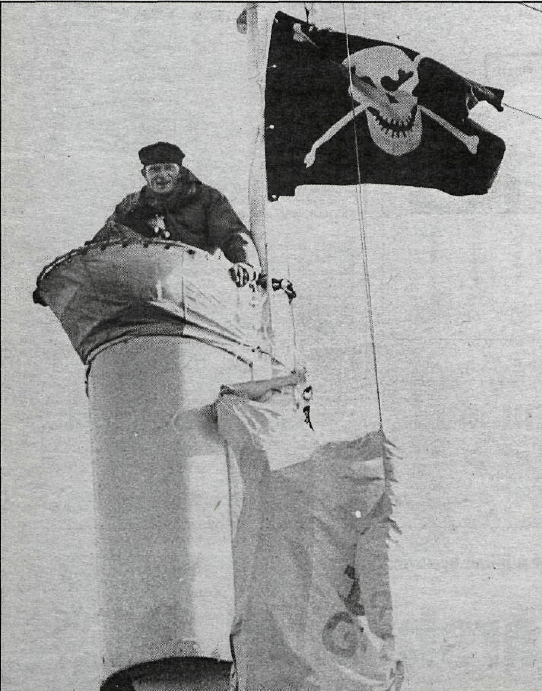
From that point on,Ragnar and Sveinbjörn drove their Dodge to their operations. One day, Ragnar boarded a whaling ship, climbed into the crow’s nest, chained himself to it with iron chains, and threw the key into the sea. It was very cold and a storm was brewing, so the sailors realised that it would be too dangerous to climb up to the crow’s nest to cut the chain with bolt cutters and forcibly remove this troublemaker from the ship. It was therefore advised that such actions would be better postponed until the following day. So it came to pass, and Ragnar gritted his teeth through the storm until the next day.
In the wake of Hreystimenn, new perspectives kept opening up, ones that were certainly capable of setting new standards. Unforgettable was the party in the attic flat of an old house in Reykjavik, where, accompanied by vegetarian lasagne and a huge tub of punch containing every fruit and spirit Iceland had to offer. The same LP was played over and over again throughout the evening and into the night, emitting nothing but the calls of whales, and they didn’t miss the chance to flip that same LP over again and again, so we could listen to the other side once more. Until, at some point, a party guest burst into the room, pointing out that an aurora borealis could be seen outside. So all the party guests climbed through the toilet’s skylight, lay down side by side on the sloping roof, and watched from this makeshift cinema the dance of the elves, who were performing in yellow dresses that day.


 résonance


